Quiver
An iOS app that breaks down the posts creators save — and hands the whole library to Claude, ChatGPT, or any AI tool.
- Industry
- iOS App & AI Infrastructure
- Location
- Great Falls, MT
- Scope
- iOS App, Backend & MCP Server, Design System, Launch Site
- Live at
- quivercontent.app
What it is
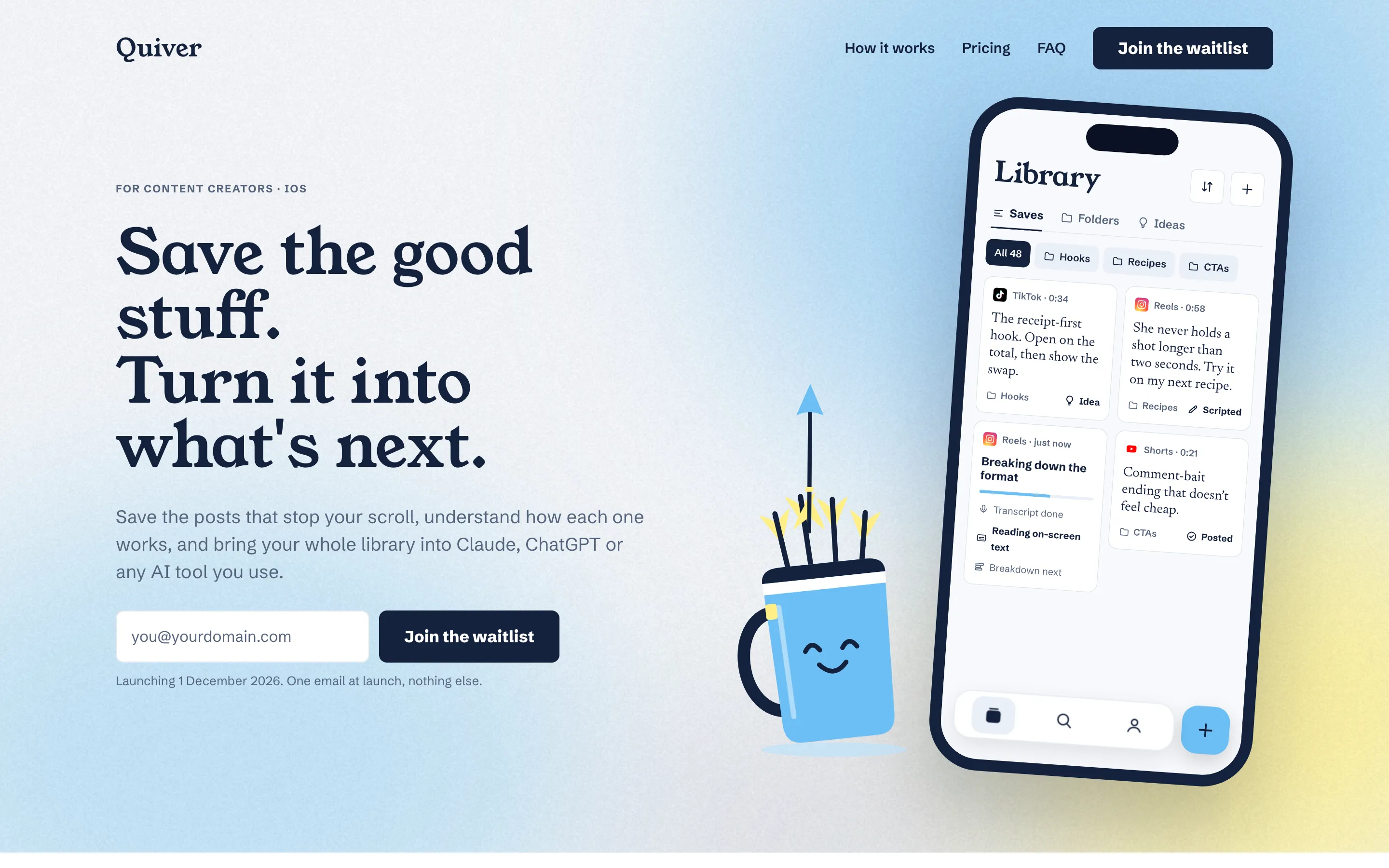
Quiver is an iOS app for content creators. Save the posts that stop your scroll, get a plain-language breakdown of how each one works, and bring the whole library into Claude, ChatGPT, or any AI tool you use — through a hosted MCP server.
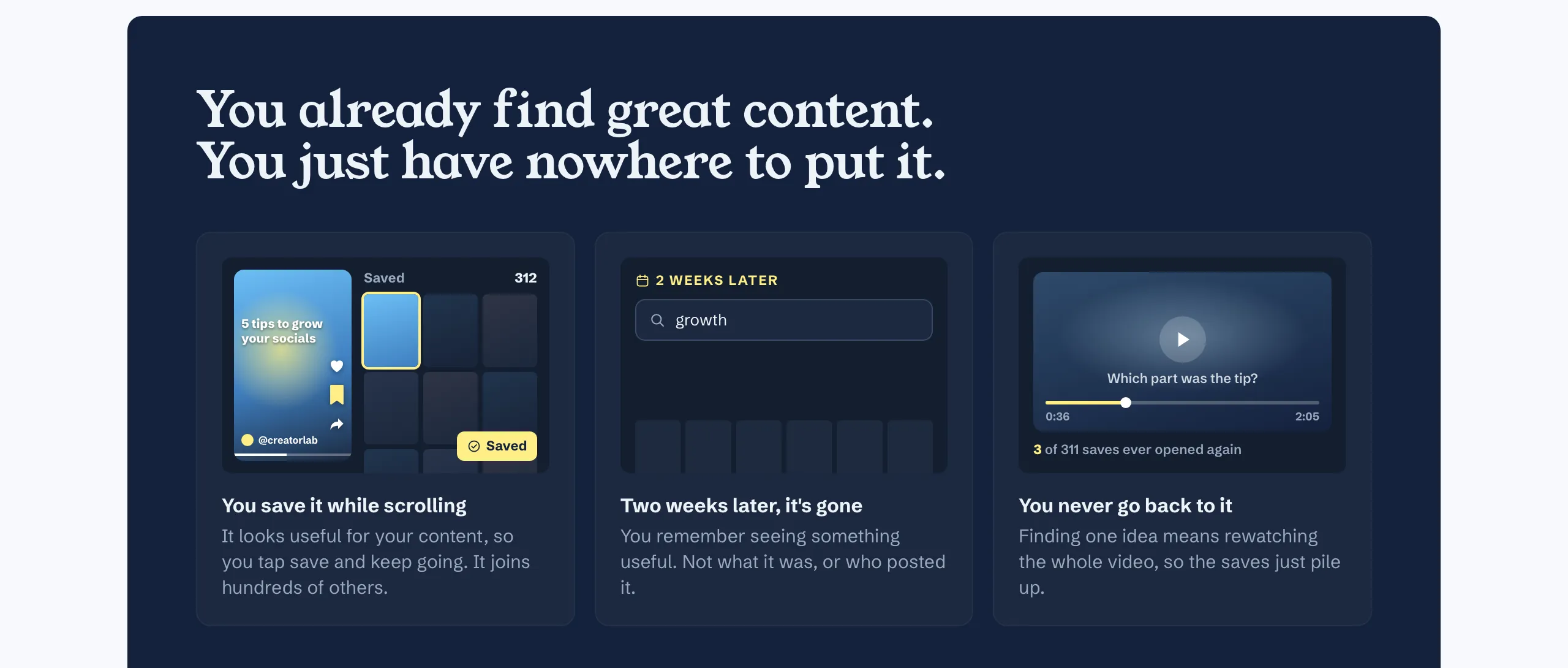
Tap share on a TikTok, Reel, or Short, pick Quiver, add a note, and you're back to scrolling. In the background Quiver reads what's said and what's on screen, breaks down the hook, structure, pacing, and call to action, and files it in a folder. Later, your AI tool can draft scripts from the formats you already rate.
It started as Cairn, a personal recall tool, and was repositioned and renamed in September 2026. The native app, backend, pipeline, and MCP server carried over; the audience, analysis, design system, and every word of copy are new.
The loop

The launch site
The decisions
What the build actually required.
Reposition without starting over
Quiver began life as Cairn, a personal recall tool. When the audience that cared most turned out to be content creators, the product was renamed and rebuilt around them — but the share extension, extraction pipeline, database, and MCP server all carried over. A new name, a new design system, and new analysis on top of infrastructure that already worked.
Protect the one-second save
The whole product dies if saving feels slow. The native iOS share extension writes the save and dismisses immediately — you're back to scrolling in under a second. Transcription, reading the on-screen text, and the format breakdown all happen after the sheet is gone.
Describe the format, never show the video
Every save gets a breakdown — format, hook, structure, pacing, call to action, and on-screen text — written plainly so a creator can reuse the shape. Quiver never stores, plays, or shows a frame of anyone else's post; it links out to the original. That rule shapes the product, the copy, and the App Store review.
Make the library work in any AI tool
The payoff isn't inside the app. A hosted MCP server exposes the whole library to Claude, ChatGPT, Cursor, or any MCP client, so a creator can say "write three scripts from the hooks I saved this month" and get drafts grounded in posts they already know work. Every tool description is UX copy.
Measure the cost before setting the price
Early estimates of per-save cost disagreed with each other by roughly 17×, so the price isn't set from a guess. Real processing cost gets measured against a real library first; the plan and the 100-saves-a-month cap follow from that number, and the cap is enforced in the database, not the client.
Under the hood
- App
- React Native + Expo, native iOS share extension, TypeScript strict
- Backend
- Node service on Railway, Supabase Postgres with row-level security and pgvector
- Pipeline
- Post → transcript + on-screen text → format breakdown → embedding → semantic search
- AI access
- Hosted MCP server with OAuth — Claude, ChatGPT, Cursor, and other MCP clients
- Design
- Token-locked "Sky" system: three typefaces, a 30-icon custom set, Lottie mascot moments
- Landing
- Astro on Cloudflare, scroll-scrubbed product demo, Supabase-backed waitlist
The landing page and waitlist are live at quivercontent.app. The app runs on device with the backend and MCP server deployed; the App Store launch is planned for 1 December 2026.
Ready to start?
Your Montana business deserves
a website that works.
Book a free 30-minute discovery call. We'll talk through what you need, what it'll cost, and what to expect — no pressure, no pitch deck.
We respond within 1 business day.